5 Min read
2 Books
2 Nights
1 POW Story
Upcoming Events
Nov 12 · Stamford, CT · Corporate event, guest speaker
Nov 15 · West Point, NY · West Point Parents Club of NY & NJ, speaker, 1:00 p.m.
Nov 18 · Washington, DC · LBJ Room, U.S. Capitol, hosting a celebration of 50 years of women at the federal service academies and honoring women veterans in the 119th Congress, presented by Engage
Feb 19, 2027 · Bronx, NY · New York Military Affairs Symposium, Fordham
Happy Veterans Day.
It’s been a busy fall, and I’ve had the honor of meeting veterans all over the country, in person and on the page.
TWO SENATORS, TWO MEMOIRS
The Engage Reader* featured my book Raising Athena and invited me to the Capitol next week. The occasion: fifty years since the first women walked through the gates of the federal service academies in the summer of 1976, and a celebration of the women veterans serving in the 119th Congress.
So I did what I do before I walk into a room. I read.
In 2003 Joni Ernst was a captain commanding an Iowa Army National Guard truck company, the 1168th Transportation Company, about 150 soldiers, the only woman officer and the first woman to command that unit. For the first half of their year in Kuwait, her soldiers drove supply convoys up into Iraq while the war was still moving forward. And they hauled everything.
“We were hauling it all,” she writes in Daughter of the Heartland. Then comes the list: Patriot missiles and concrete barriers, refrigerated vans of fresh fruit and vegetables, body armor, bunk beds, MREs, ammunition, mail, and embalming powder. Four hundred and two missions, more than 230,000 miles, in cab-over trucks with no air conditioning, the soldiers sitting on top of the engines with the windows down at fifty miles an hour in 120-degree heat and blowing sand. And they did much of it without maps. Imagine that. Four hours of sleep was the regulation minimum, and they pushed it.
Nobody makes a movie about the truck company. But nothing moves without it.
Tammy Duckworth was a Black Hawk pilot, and she loves the self-deprecating streak in Army aviation: not jet jocks, not Top Guns, but, in her words, “the grunt pilots of military aviation.” In Every Day Is a Gift she quotes Harry Reasoner’s 1971 ABC commentary, a favorite passage in the book, on why helicopter pilots are a breed apart. An airplane wants to fly, he argued, and a helicopter doesn’t; it stays up only by forces working against each other, and the moment that balance breaks, it falls. “There is no such thing as a gliding helicopter.”
Eight months into her tour, on November 12, 2004, an RPG tore through her cockpit north of Baghdad. Her crew got the aircraft down and pulled her out believing they were carrying back what was left of her, a body. She lost both legs. She lived.
Two senators, two parties, two different roads into uniform. Both were, more often than not, the only woman in the room. Ernst’s answer to partisanship, by the way, is to elect more women.

TWO NIGHTS WITH THE NEXT GENERATION
The past two nights I sat with an amazing group of veterans for my congressional district, interviewing young Americans seeking a nomination to the federal service academies.
Combat veterans with multiple deployments. Lifers. Men and women from various backgrounds. We came together to greet families and to meet the next generation who want to serve.
In Raising Athena I wrote about a cadet who “had taken the first step: showing up.” That’s what I saw across the table: seventeen- and eighteen-year-olds in jackets and ties on a weeknight, asking for the chance to serve.
Fifty-one years ago, the young women among them would not have been allowed to apply.
MIKE BENGE: I WAS, AND I AM
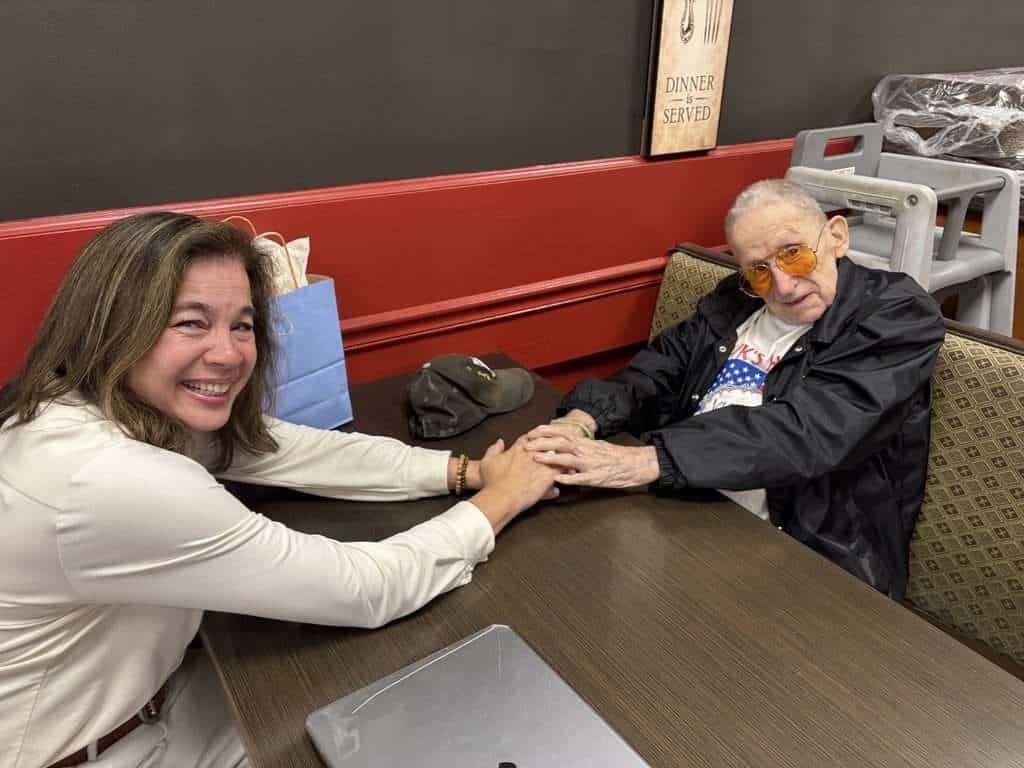
In September I spoke at the POW/MIA event at the Palm Springs Air Museum, in the Vietnam hangar. The heart of that night belonged to Mike Benge: Marine veteran, civilian aid worker, and my father’s friend.
In 1968, during the Tet Offensive, Mike called my father to ask for two planes to evacuate the civilians in his province. My father said yes. Mike spent the morning driving house to house under fire to tell people where to meet. North Vietnamese soldiers took him before the planes came. Everyone else got out. Mike didn’t, not for five years.
He was marched barefoot nearly a thousand miles, chained to two missionaries who both died on the trail, held twenty-seven months in solitary. When he reached the camp in the North, his hair had turned white. He was thirty-three.
He’s ninety-one now. When I asked what he wanted me to tell the room, he said: “I was a survivor. I WAS, and I AM.”
Watch the full speech here. (Video with photos, thank you Dr. Dave Thompson!)
Mike’s story, as I told it that night, is below.*
A truck commander who hauled everything. A pilot whose crew carried her home. A table of veterans handing the work to seventeen-year-olds.
Less than one percent of this country puts on the uniform. Many, like Mike, continued to serve in uniform and out of it. Today, thank them.
Happy Veterans Day.
MyLinh
FOOTNOTES
*the Engage Reader features Raising Athena in its upcoming issue to be released next week during the Celebration of 50 years of women at the federal service academies at the Capitol. Engage was founded by Rachel Pearson to promote women’s economic security. Learn more here: https://www.engagewomen.org/about
**If you have five minutes, read a bit more of his story, which was the highlight of the speech. He is a Marine veteran who was captured after his military service while working as a civilian.
- MIKE BENGE: THE FULL STORY
Script notes from the Palm Springs Air Museum POW/MIA event, September 2026
Mike Benge served in the U.S. Marine Corps first — enlisted in 1956, made sergeant, honorably discharged in 1959. A Marine before he ever set foot in Vietnam as a civilian.
In 1963 he joined International Voluntary Services, the forerunner of the Peace Corps, and served two years in the Central Highlands. That’s where he met my father. The two of them spent evenings singing together with friends, my father on guitar.
By 1968 he’d transferred to the Agency for International Development, working almost entirely with the Montagnards, a French word for the people who lived in the mountains. He spoke Vietnamese and several tribal dialects. The Montagnards respected him.
On the night the Tet Offensive reached his province, Benge was on the roof of his own villa with a friend, exchanging rifle fire with North Vietnamese troops infiltrating the town. By morning the shooting had thinned out enough for him to reach out for help.
He called my father. At the time, my father was USAID’s operations officer for Air America, working out of regional headquarters up the coast in Nha Trang. Mike asked for planes — two C-47s, the same aircraft you can still see at the museum — to evacuate roughly seventy-five American and allied civilians working under his supervision in the province. My father said yes.
Mike Benge spent the rest of that morning driving house to house across the province, under fire, telling people where and when to meet for the evacuation. He reached the missionary compound on the edge of town, climbed up on top of his jeep, and shouted up the hill for them to be at his villa by eleven. They waved back. He thought that meant they understood him.
What they were actually trying to warn him about was the North Vietnamese soldiers coming up the ravine behind him.
He didn’t see them until he turned around. Thirteen of them, armed, waiting. They took him prisoner right there — tied his hands with communications wire, put a loop around his neck, took his shoes, and marched him out barefoot across scorched clay.
That was the day my father lost touch with him. Mike has told me that the call for those evacuation planes — that conversation with my father — was one of the last free conversations he had. The C-47s would come and evacuate everyone, but not Mike.
For his efforts rescuing several Americans before his own capture, Mike later received the State Department’s highest award for heroism — and a second award, for valor, during his captivity.
Mike Benge didn’t reappear for five years.
Most POWs of that war were pilots — shot down and held near Hanoi, never marched anywhere. Mike was one of the few captured on the ground, in the Central Highlands, and walked the whole way north: through South Vietnam, Cambodia, Laos, into North Vietnam. Chained for months at a stretch to two missionaries, Betty Ann Olsen and Henry “Hank” Blood, force-marched nearly a thousand miles through jungle and mountains, fed almost nothing. His body broke down under him — his teeth loosened, his gums bled, his skin ulcerated. Twenty-seven months of it, in solitary confinement — alone, in the dark. Tortured, Mike says, for his “bad attitude.”
Hank Blood died of pneumonia on the trail that summer. Betty Ann kept Mike alive through a bout of cerebral malaria that left him delirious for thirty-five days — she forced him to eat, to drink, to keep moving.
Mike told me recently that he gave her something too — a phrase he’d picked up somewhere along the way, half Latin, half joke: Illegitimi non carborundum. Don’t let the bastards grind you down. He said it to her, over and over, for encouragement, to keep her going.
She died that September. Mike buried her with his own hands.
The last words she said to him were Illegitimi non carborundum.
By the time he reached the camp the North Vietnamese called “the land of milk and honey,” his hair had turned white. Other prisoners guessed his age at seventy.
He was thirty-three.
He was released March 5, 1973, in Operation Homecoming.
Tony Orlando’s song “Tie a Yellow Ribbon” was written about a man coming home from prison, not knowing if anyone still wanted him back. Mike Benge came home to a country that had mostly never heard his name — he wasn’t a downed pilot, he wasn’t in uniform when he was taken. He was a civilian aid worker most Americans had no reason to know.
He went back to Vietnam after his release anyway. Kept working with the Montagnards until the war ended for good, in 1975. Went back to school afterward, earned a master’s degree in the Philippines. Spent another twenty years in international development, in forestry and the environment — work that was good enough that the King of Sweden gave him an award for it, modeled after the Nobel Prize. He raised two daughters.
Mike Benge is alive today. Ninety-one years old. He is funny, sharp, still working on his memoirs. More than fifty years and one lifetime removed from Hanoi, he still calls my father one of his best friends.
I spoke with Mike before the event. I asked him what he’d want me to tell the room at this POW/MIA event.
His voice is older now, a little worn. But his mind is sharp. He said:
“I was a survivor. I WAS, and I AM.”
Learn more about the book, Raising Athena: A Mother and Daughter Attend West Point Thirty Years Apart.
See all upcoming events.

0 Comments