3 Min read
One book rec
On Writing
Toolbox
*
Easy reading is damn hard writing.
Nathaniel Hawthorne
*
Upcoming Events
Nov 12 · Stamford, CT · Deloitte & Touche Town Hall and Fall Reception, guest speaker (private event)
Nov 15 · West Point, NY · West Point Parents Club of NY & NJ, guest speaker, 1:00 p.m.
Mar 2, 2027 · Wilton, CT · Wilton Library, author talk for Women’s History Month, 6:30 p.m.
Notes for Writers from Harlan Coben’s Plot Twist
At an authors panel in Alexandria, a woman asked for advice on writing a book. I took the mike and explained my belief in 10,000 hours. And the reality that for some of us, it takes more. The only way to have writing is to set the time aside, keep your butt in the chair, and write.
I thought of her this week as I finished Harlan Coben’s new book, Plot Twist: Life, Craft, and the Messy First Draft. Part memoir, part masterclass. Coben has more than 100 million books in print and has written, by his own count, 38 novels (“I think,” he says). He wrote his first novel at 21.
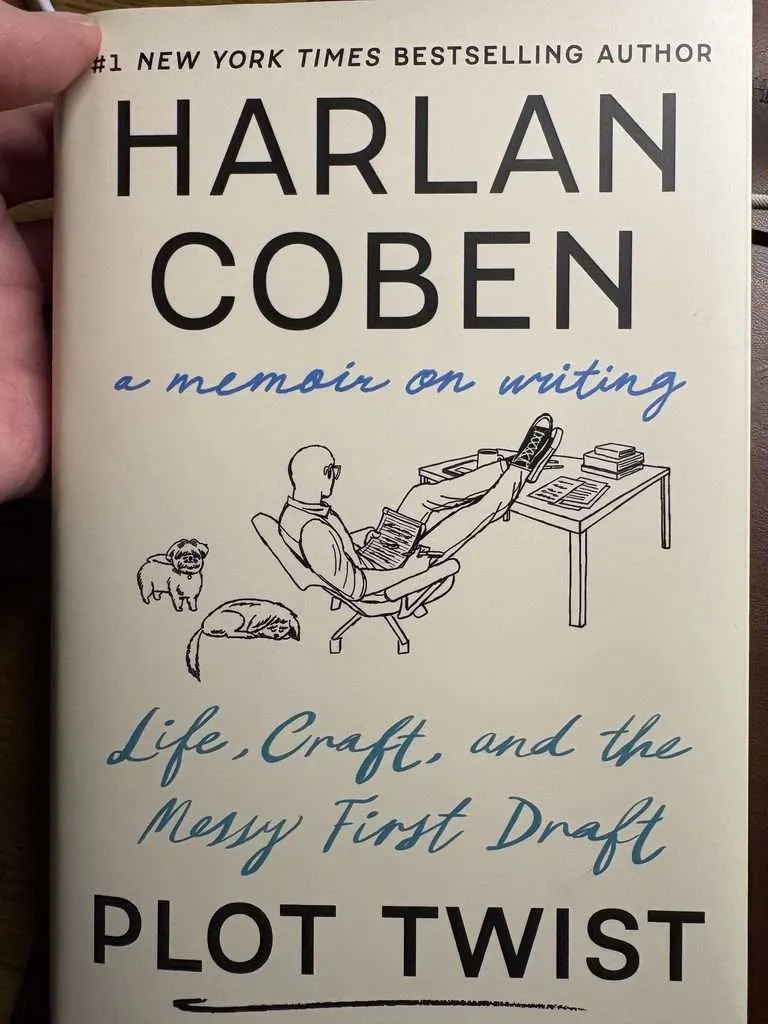
So much good stuff. These are nuggets for writers, for folks serious about craft, and for readers curious about the craft of writing. Here are quotes from my tabs in his book. For the writing toolbox.
*
1. Where Ideas Come From
Ideas come from what-ifs, personal life, news stories, and what you’re reading and hearing about. Then you combine these and blend ideas. (Harlan Coben, Plot Twist, p. 38)
2. Don’t Whine
In another chapter (they’re enumerated, no titles), he tells you the stories. Then he concludes:
Don’t whine.
p. 106
Don’t listen to the rejection letters. And quit “taking comfort in faux rationales,” because that doesn’t help. Do better. “The writers who publicly whine about how unfair it all is never make it.” p. 104
3. Narrow and Specific
I especially love this one:
If you want your appeal to be wide and universal, make your writing narrow and specific.
p. 140
4. Research Less
You should do as little research as possible.
p. 194
That’s the same advice I received from my advisor in my MFA. More like: you can research forever. So, start writing.
5. Keep an Idea File
Everything inspires. Books, movies, television, paintings, sculpture, cheesy pop songs. Write it down. Keep it. (p. 254)
6. More Real Than Reality
This one writers learn somewhere along the way:
Fiction has to be more real than reality.
p. 262
How so, you ask? If it’s fiction, readers won’t believe it’s possible. If it’s nonfiction, then it actually happened. You don’t have to convince anyone. Life gets away with things a novel never could.
7. Easy Reading
Friends and readers poo-poo easy writing. Know this, as Coben quotes Nathaniel Hawthorne:
Easy reading is damn hard writing.
p. 298
*
Why Coben
I’ve read one of his books, I Will Find You, after a challenge to my book club: choose pulp fiction, best-sellers. Figure out what the masses read, and why. I Will Find You debuted at #1 on the New York Times list in 2023. Now that I’ve read his book on writing, I know more about the man and what he did to become a number one New York Times best-seller.
I like Harlan Coben more after reading this book on craft.
Easy reading is damn hard writing. Ten thousand hours. For some of us, more.
Write.
— MyLinh
*
One Book Rec
Plot Twist: Life, Craft, and the Messy First Draft
Harlan Coben | Grand Central Publishing | September 2026
See all upcoming events at treehouseletter.com/events

0 Comments