2 Min read
Audiobook
Bookclubs
Discussion guide
*
*
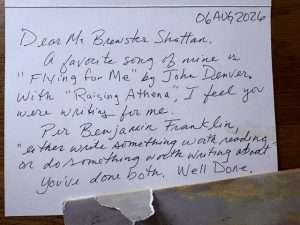
[Reader letter – full text]
Dear Ms. Brewster Shattan,
A favorite song of mine is “Flying for Me” by John Denver. With “Raising Athena,” I feel you were writing for me.
Per Benjamin Franklin, “either write something worth reading, or do something worth writing about.” You’ve done both. Well done.
E—-
*
It’s been a while. Since April, Raising Athena has been out in the world — the book launch at the Athena conference at West Point, an author segment on NBC News Daily, and a new milestone.
The audiobook is officially live.
I’m narrating — it took me 35 hours to get 11 hours of audio — and I’d love to hear what you think.
If you’ve been meaning to read it and haven’t found the time, or you’re someone who prefers listening on a commute or a walk, it’s now available wherever you get your audiobooks.
*
Book Clubs
If you’re in a book club — or know someone who is — I’d love for Raising Athena to be part of the conversation. I’m happy to:
- Donate copies to your group
- Join your discussion
- Both — books now, conversation to follow
The book has resonated with readers as a window into the world of those who serve and the families who love them. With the 250th birthday of the nation and the 50th year since women’s integration at the federal service academies, this work is timely.
A discussion guide and book club questions are on the book page for your reference and use.
Reply to this email or reach me directly at mylinhshattan@gmail.com if you want to read for your book club.
Thank you, as always, for reading.
MyLinh
*
FOOTNOTE
*Book club questions below. Use this link for a Discussion Guide.
Dear fellow readers,
Thank you for choosing Raising Athena for your group. I’m honored, and I hope it was worth the time you gave it.
I set out to write this for myself. I needed to understand why anyone chooses this life — why I did, at West Point in 1987, and why my daughter Cara did, thirty years later. The writing wasn’t outlined or planned; it was a search, and the discovery often came as a surprise. I hope the story will make for meaningful and engaging conversation.
Below are questions, first general, then organized by theme because I like how it lets a group linger on what matters to them.
With gratitude,
MyLinh Shattan
General Questions
- What was your overall impression of the book? What surprised you most?
- Of all the real people who appear in these pages — the author and Ox, Cara and Grace, Cashman and Mintz, the wedding guests in “Why They Serve,” the author’s mother and father — who interested you most as a reader, and why?
- What was your favorite scene or chapter? Why did it stay with you?
- If you could ask the author one question she didn’t answer in the book, what would it be?
On Duty and Service
- The author sets two class mottos side by side — her own, “Duty Shall Be Done,” and Cara’s, “Until the Battle Is Won.” What does each motto suggest about how its generation understood duty?
- In “The Arena,” the book draws on Theodore Roosevelt’s “Man in the Arena” speech — the credit belonging to “the man who is actually in the arena,” who risks failure rather than standing safely outside. Where do you see this idea tested in the book, for the author, for Cara, or for someone else in these pages?
- “Why They Serve” gathers people who did serve and people who chose not to, from different countries. What did that teach you about the reasons behind service — or the reasons behind opting out?
On Fear and Letting Go
- The unsent letter in “Dear Cara” is one of the most personal passages in the book — written, the author says, as much for herself as for her daughter. What did you make of a mother writing a letter she wasn’t sure she’d ever send?
- The author writes about fear throughout the book — of her daughter’s risk, of her own past, of what she calls “the growing divide between a society and its defenders.” Which kind of fear felt most alive to you as a reader?
- What does the book suggest about the difference between protecting a child and preparing one?
On Memory, Myth, and Women Warriors
- The title comes from a passage in “Dear Cara,” where the author compares seeing her daughter in uniform to Athena springing fully formed from the head of Zeus. Separately, the chapter “A Superpower” describes the West Point crest itself, which carries Athena’s helmet and sword. What does it mean that this myth is both a private, personal image and a public, institutional one?
- Each of the book’s three parts opens with a line tracing Odysseus’s journey, ending with Cavafy’s “Ithaka” — “it is ultimately not the destination but the experiences along the way that enrich our lives.” How did this structure shape your reading of the book as a whole?
- The author writes about the stories we tell ourselves, “the disconnect between myth and reality.” Where in the book did myth and reality pull apart for you as a reader — and where did they align?
On the Helicopter
- The helicopter recurs across the book: it carries the author’s father off the embassy roof, it medevacs PFC Danny Gronde and Heath McClung, and in the epilogue, Blackhawks fly over Michie Stadium at an Army football game. The author writes it came to mean “fleeing and freedom” rather than “flying and firepower.” Trace this image through the book — what does it mean at each point it appears, and how does that meaning shift?
- Why do you think the author chose to open and close the book with two different helicopters, fifty years apart?
On Women at West Point, Then and Now
- The book documents real changes for women between 1987 and Cara’s years — mandatory boxing, the gender-neutral fitness test, improved sexual harassment reporting. Which of these surprised you most?
- What hasn’t changed, according to the book — and what did that surprise or trouble you?
On Loss and the Cost of Service
- “Final Roll Call” names graduates who died — to combat, to accidents, to suicide — including 1LT Laura Walker and Bill Hecker. How does the book hold this grief alongside its larger argument about duty?
- The epilogue mentions the author’s mother’s death during the book’s publication. How did that detail change how you read the rest of the book, if you knew it going in, or looking back now that you do?
On Change
Did the story of MyLinh and Cara challenge or inspire you to change in any way? How?

0 Comments